Our Communities Can’t Wait – Please Consider Donating

Covid-19 is an existential crisis that impacts everyone.  While some have been able to work from home, many of our neighbors are making difficult tradeoffs between paying rent, putting food on their table, and keeping their kids engaged in remote learning. The state unemployment rate has skyrocketed from 2.4% to as high as 32.6% in hard-hit cities, pushing more than 330,000 families deeper into financial crisis

Since the start of the COVID-19 crisis, United Way of Massachusetts Bay and Merrimack Valley has raised and distributed over $8 million to more than 300,000 vulnerable people, providing emergency financial assistance of $300 on average to help pay for food, rent/housing, utilities, and other basic needs. More than 100,500 households received food assistance, 3,500 households had utility/rental help and another 8,000 households received general financial assistance. One hundred percent of donations to United Way were distributed to families in need. In some of our target communities, many applicants for financial assistance have had no income since mid-March.

Six Headlines of the Current Crisis

  1. The MA unemployment rate skyrocketed from 2.8% before Covid-19 hit to over 16% this summer.
  2. We are bracing for a potential 60,000 evictions, more than triple the 16,000 in an average year.
  3. COVID led to the loss of 800 beds, pushing an already strained homeless shelter system to the brink.
  4. Racial and economic inequities are more glaring than ever. Rates of infection, unemployment and food insecurity as much as 3x and 2x higher for Black and Latinx residents.
  5. The early education sector is in a perilous situation, losing $250 million during the shutdown.
  6. Remote learning has brought in a whole new set of challenges for families, afterschool programs and for an estimated 127,000 students in our region.

United Way has the scale and reach to help.  Join us in raising $52 million to lead a comprehensive community response to the ongoing crisis.
Please CLICK HERE to donate.

Please CLICK HERE for more information.

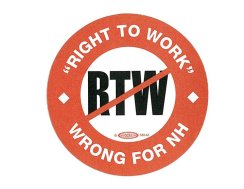
“Right to Work” is Wrong for NH

NH Members, your friends and family in NH can use THIS LINK to look up your elected officials, and urge them to VOTE NO on Right to Work! 

Despite the misleading name, so-called “right-to-work” laws do not guarantee anyone a job and do not protect workers’ rights. 

“Right-to-work” laws prohibit trade unions from collecting fees to cover the cost of contract administration from employees who benefit from the protections of a collective bargaining agreement, but do not join the union. There are different versions of “right-to-work” legislation, but all so-called “right-to-work” laws are designed to limit the power of labor unions, and the workers they represent, to negotiate for better pay and working conditions.

Federal law requires trade unions to equally represent all workers covered by a collective bargaining agreement, regardless of union membership status. In states without so-called “right-to-work” laws, private employers and their employees are free to negotiate agreements that ensure everyone who benefits from a union contract contributes a share of the costs of obtaining and protecting those benefits. By prohibiting unions from asking non-members to pay a “service” or “fair share” fee to cover the basic costs of contract administration, so-called “right-to-work” laws give state governments the power to limit the terms and conditions that private-sector employers and their employees have a right to negotiate as part of a collective bargaining agreement.

Labor unions in “right-to-work” states are forced to absorb the costs of grievance and arbitration procedures on behalf of non-members who benefit from the terms of a bargaining agreement, but who do not contribute to the union’s operating fund. By draining resources and hurting the ability of unions to grow, “right to work” laws are consistently linked with lower average wages and reduced workplace safety for all working people in states that have passed the legislation.

Well-funded “right-to-work” proponents include the National Right to Work Committee, U.S. Chamber of Commerce, American Legislative Exchange Council (ALEC) and Americans for Prosperity. While supporters typically claim that “right-to-work” laws are necessary to attract new businesses and increase employment opportunities, rigorous economic studies fail to validate such claims.


FOR MORE INFORMATION:

NH AFL-CIO 2017 briefing pamphlet (PDF): Know the Facts About Right to Work

A Tale of Two States (and what it tells us about so-called “Right to Work” laws)
By Ross Eisenbrey and Teresa Kroeger, Economic Policy Institute, January 12, 2017

“Right-to-Work” States Still Have Lower Wages
By Elise Gould and Will Kimball, Economic Policy Institute, April 22, 2015

In Solidarity With Our Union Brothers and Sisters on the Frontlines

We currently have more members who have tested positive for COVID-19 than we have at any point since this pandemic began.  COVID-19 cases, hospitalizations, and deaths across the United States are rising. Take steps to slow the spread of COVID-19.

We at Local 2222 know what it means to stand united with our Union Brothers & Sisters. Let’s show our solidarity with frontline workers – nurses, police, firefighters, EMS, teachers, grocery workers, postal workers – by wearing our masks, by practicing social distancing, by adhering to all guidelines in place. Let’s keep them safe, keep our co-workers safe, keep ourselves safe, so we can all make it safely home to our families.


VZ Corporate Profit Sharing (CPS)

Eligible Verizon employees have the option to defer their entire CPS award into their Verizon Savings Plan account. Employees who wish to defer their CPS award must take action between January 4th 2021 and February 5th 2021.
 
Employees who choose not to defer will receive their CPS award on March 5th, 2021 in a separate paycheck/direct deposit. 
 
The letter below, which details the steps to take if you choose to defer your CPS, will be emailed to all employees.  Employees on a leave of absence or disability absence will receive the letter in the mail.
 

COVID-19 Update

Please be advised that if you have applied for a COVID-19 LOA, including if you have been instructed to quarantine, the Verizon HR COVID-19 Group will contact you via email, using the email address you provided when completing the LOA form.  Please check your email frequently.


The IBEW & CWA reached an agreement with Verizon to extend the Work at Home Agreement through April 30, 2021.  Click HERE to read the agreement.

We have also reached an agreement to extend Home Garaging through February 28, 2021.  Click HERE to read the agreement. 

New FMLA Authorization Changes

Effective immediately, Sedgwick will add the FMLA Medical Authorization Form to the Short Term Disability (STD) packet sent at the start of an absence.  This change due to feedback received from the Department of Labor that two separate authorizations are required.  Previously, only one authorization was included in the packet for both FMLA and STD claims. 

All employees will need to complete both the:

  • FMLA Authorization (Voluntary Authorization to Seek Clarification or Authentication on FMLA and/or State FMLA Certification)
  • STD authorization (Medical Authorization) in order for Sedgwick to contact the health care provider regarding either the FMLA or STD claim. 

Insurance Reminder for VZ Members

For members with college-aged students, remember you must certify your dependent child is a full-time student when they reach 19 years of age.  If you fail to do so, they will lose their dental and vision insurance on December 31st of the year of their 19th birthday.

To certify Full-Time Student Status:

If you have any problems or questions please call the Union office 617-929-6000

« Older Entries Recent Entries »